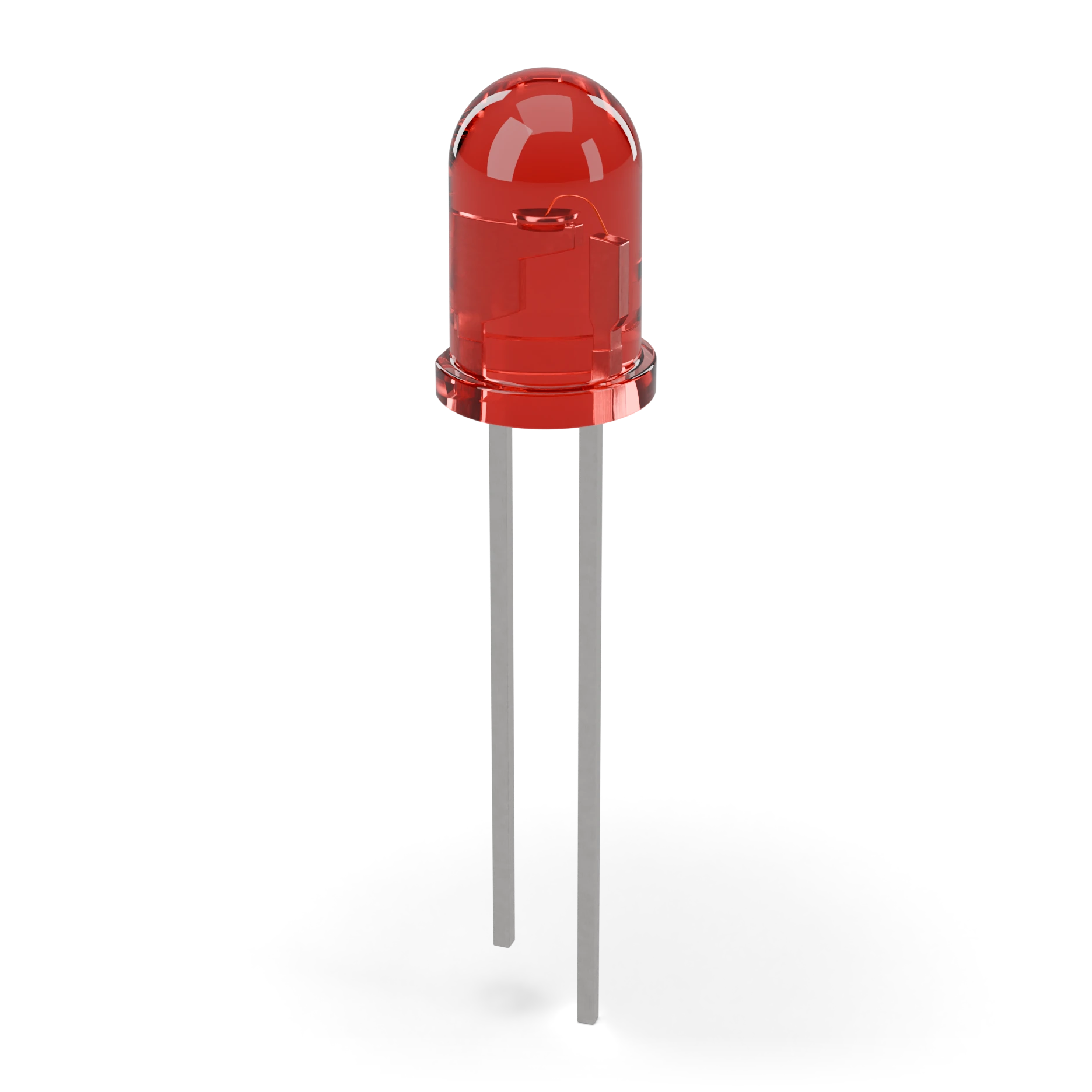
- 1Epoxy lens · Ø 5 mm
- 2Cathode frame (anvil)
- 3Anode frame (post)
- 4Cathode leg (−) · short leg
- 5Anode pin (+) · long leg
5 mm diameter, body height ≈ 8.6 mm (3 mm type also common)
LED
A small diode that gives off light; it glows as current flows and works in one direction only.
Lights up as a power and status indicator; it shows the circuit is working.
The small lights on a modem, a charger and a TV.
A domed coloured plastic body and two legs; the long leg is positive, the flat edge of the dome is on the negative side.
Do not connect it without a series resistor, or it burns out; long leg to plus.
A light-emitting diode: as current passes from anode to cathode, the semiconductor chip gives off light. Its color depends on the chip’s material, and the forward voltage changes with color. It is always used with a series resistor.
IEC 60617: the drawing style used in Türkiye and Europe.
- Forward voltage (red)
- 1.8–2.2 V
- Forward voltage (blue/white)
- 3.0–3.3 V
- Continuous current
- 20 mA (max.)
- Recommended current
- 5–15 mA
- Reverse voltage
- max. 5 V
- Resistor calculation
- R = (Vsupply − Vf) / I
- Example
- 5 V, red, 15 mA → 200 Ω (pick 220 Ω)
- Example part
- 5 mm red LED
Test with a multimeter
Test whether this part is good with the multimeter on the measurement screen.
Take a measurement