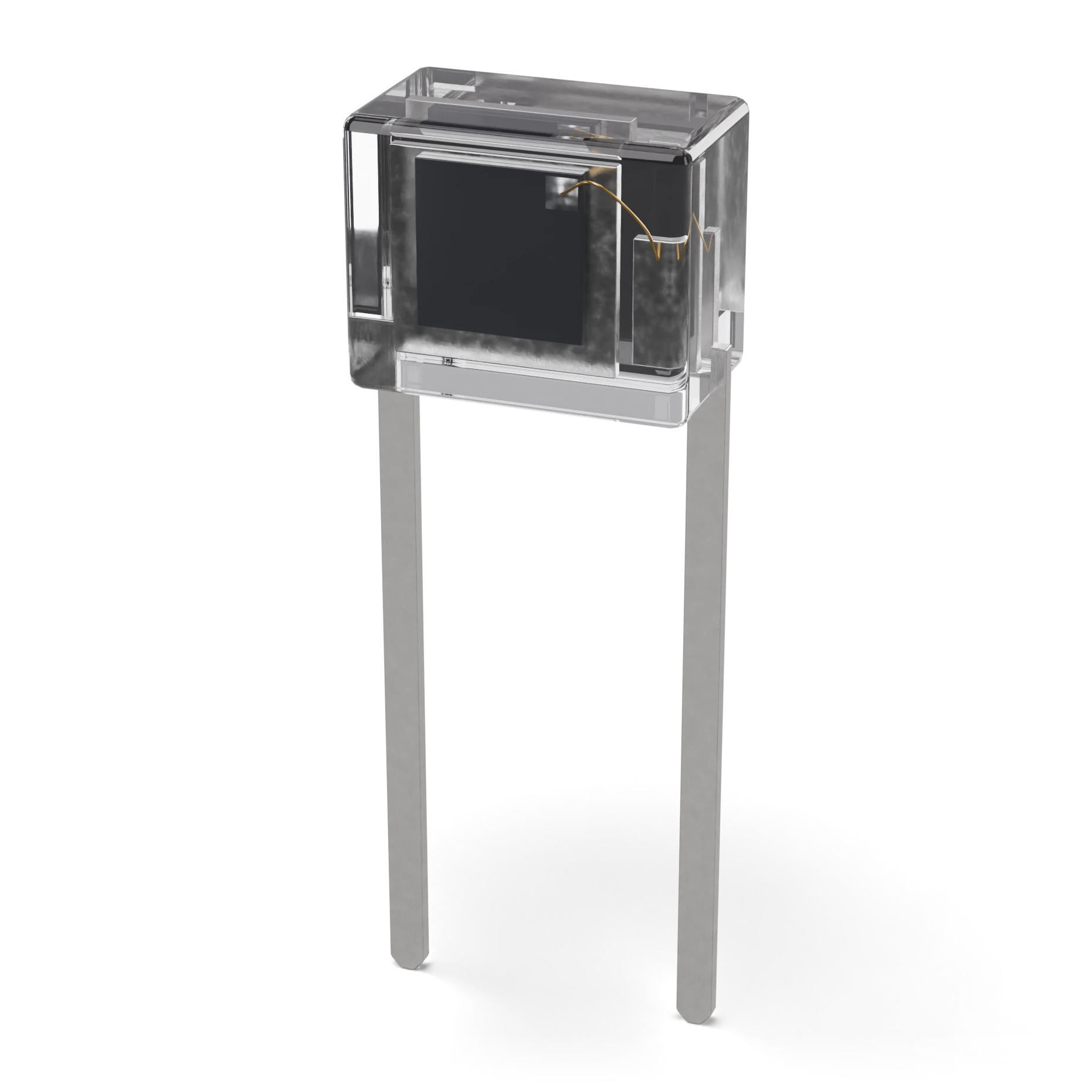
- 1Clear epoxy body · 5.4 × 4.3 mm
- 2PIN photodiode chip · light-sensitive area 7.5 mm²
- 3Cathode pin
- 4Anode pin
BPW34: ≈ 5.4 × 4.3 mm flat body, light area 7.5 mm²
Photodiode
A small diode that generates electricity when light hits it; the more light, the more current.
Detects light very fast; used for remote control signals and for measuring light intensity.
In TV and air conditioner remote-control receivers, and in pulse monitors.
A small body with a clear or dark window facing the light, and two legs.
It is usually connected in the reverse direction; if you connect it the wrong way it seems not to work.
A diode that produces current when light falls on it. It is usually connected in reverse; the reverse current rises almost linearly with the incoming light. It is much faster than an LDR, so it is used in remote-control receivers and light meters.
IEC 60617: the drawing style used in Türkiye and Europe.
- Max. reverse voltage
- 60 V
- Spectral range
- 430–1100 nm
- Peak sensitivity
- ≈900 nm
- Dark current
- ≈2 nA (10 V)
- Photocurrent
- ≈50 µA (1 mW/cm², 5 V)
- Rise time
- ≈100 ns
- Example part
- BPW34
Test with a multimeter
Test whether this part is good with the multimeter on the measurement screen.
Take a measurement