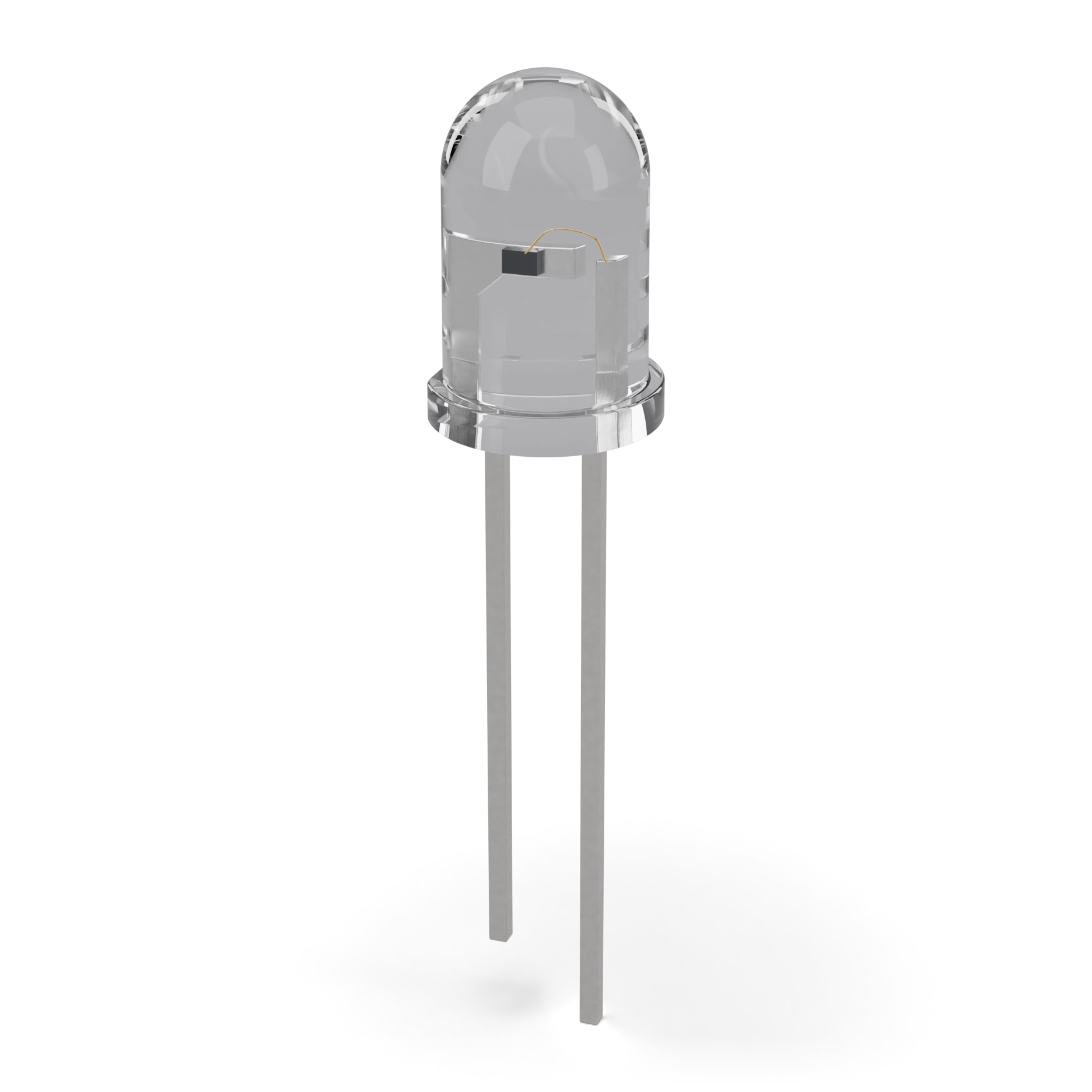
Clear epoxy lens · Ø 5 mmPin frameCollector (short pin, flat edge)Emitter (long pin)
- 1Clear epoxy lens · Ø 5 mm
- 2Pin frame
- 3Collector (short pin, flat edge)
- 4Emitter (long pin)
Clear or dark 5 mm dome, two legs; looks like an LED
3 mm or 5 mm LED-style body; clear, or dark with an IR filter · Example shown: 5 mm clear NPN phototransistor (two pins)
3 mm or 5 mm LED-style body; clear, or dark with an IR filter · Example shown: 5 mm clear NPN phototransistor (two pins)
Phototransistor
In simple terms
What is this?
A valve that sees light; the more light, the more current it lets through.
What is it for?
Picks up the light inside the optocoupler and switches the output circuit on; it is the eye of line-following robots and beam sensors.
Where do you see it?
In the optocouplers inside chargers.
How do you spot it?
A small body with a window facing the light, usually with two legs; it has no base leg.
Caution:
It is slower than a photodiode; do not dirty the light window.
Technical definition
A transistor where light at the base acts like base current. More light increases collector current. Gain gives much more current than a photodiode, but slower response. Most have just two pins (C and E).
DrivingLight (instead of the base)
OutputFrom µA to mA
Speedµs level
Schematic symbol Same in IEC and ANSI
IEC 60617: the drawing style used in Türkiye and Europe.
Pins 2
1Collector (C)To plus through a pull-up resistor; pin order varies by modelC
2Emitter (E)On an NPN type it goes to groundE
Features typical
- Operation
- Light acts like base current
- Output current
- From µA to mA depending on light
- Sensitivity
- Most types are most sensitive in near IR
- Speed
- Microseconds (slower than a photodiode)
- Connection
- Pull-up on the collector, emitter to ground
- Example part
- Found inside the TCRT5000 and PC817
Common mistakes
Connecting it backwardsIn an NPN phototransistor, the collector goes to positive through a resistor and the emitter to ground. If you connect it backwards, it hardly responds at all.
Forgetting ambient lightThe sun and lamps also contain IR. Shade the sensor or use pulsed (modulated) IR.
Test with a multimeter
Test whether this part is good with the multimeter on the measurement screen.
Take a measurementWhere it is used
Optocoupler outputLine-following robot sensorBeam-break counterOptical encoder
Related lessons