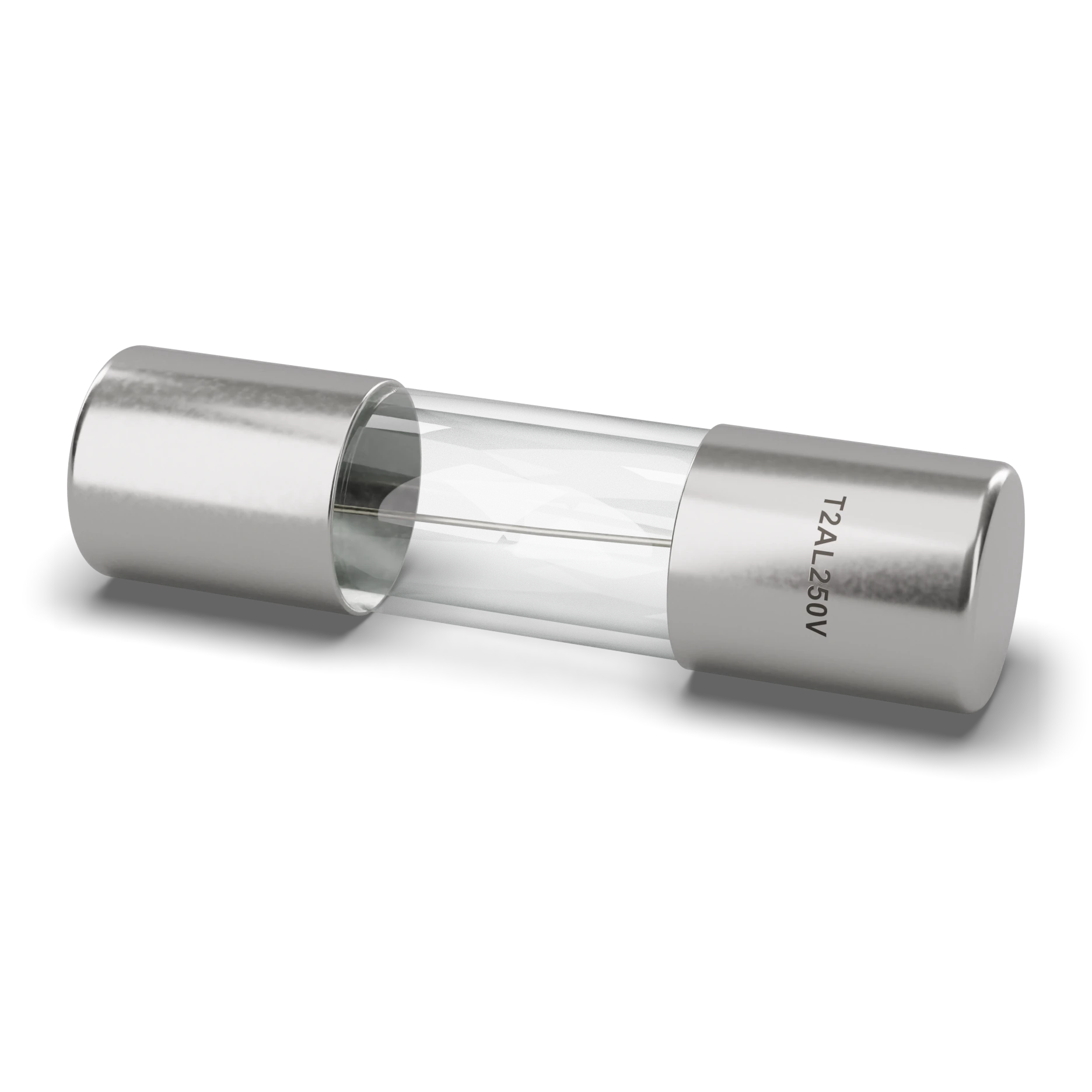
- 1Glass tube · 5 × 20 mm
- 2Nickel-plated end caps
- 3Fuse wire (melts) · T2A: slow-blow 2 A
- 4T2AL250V marking
Tube and caps ≈ Ø 5 × 20 mm; with a matching fuse holder
Glass fuse (5×20 mm)
The deliberately weak link of the circuit. When too much current arrives, its thin wire melts and breaks the chain; the remaining parts are saved.
Opens the circuit on overcurrent and protects the wire and parts from burning; single use.
In the current input of a multimeter, and inside some adapters and devices.
Clear glass tube with a metal cap at each end and a thin wire inside; its current and voltage ratings are printed on it.
Never replace a blown fuse with one for a higher current; nothing would protect the wire anymore.
The thin metal wire inside the glass tube melts and opens the circuit when enough overcurrent flows for a certain time. It is single-use and is connected in series with the line to be protected. F is fast, T is time-delay; the choice depends not only on the current but also on the trip time, voltage and breaking capacity.
IEC 60617: the drawing style used in Türkiye and Europe.
- Size
- 5 × 20 mm
- Rated current
- 1 A example; chosen by the load
- Speed
- F fast · T time-delay
- Voltage
- Example marked 250 V; the DC rating is verified separately
- I²t
- Integral of the current squared over time, A²s; depends on the series
- Breaking capacity
- Depends on the series and the AC/DC condition
- Replacement
- When it blows, replace it with the same value and type
- Example part
- F1A 250 V or T1A 250 V, 5×20 mm glass fuse
Test with a multimeter
Test whether this part is good with the multimeter on the measurement screen.
Take a measurement