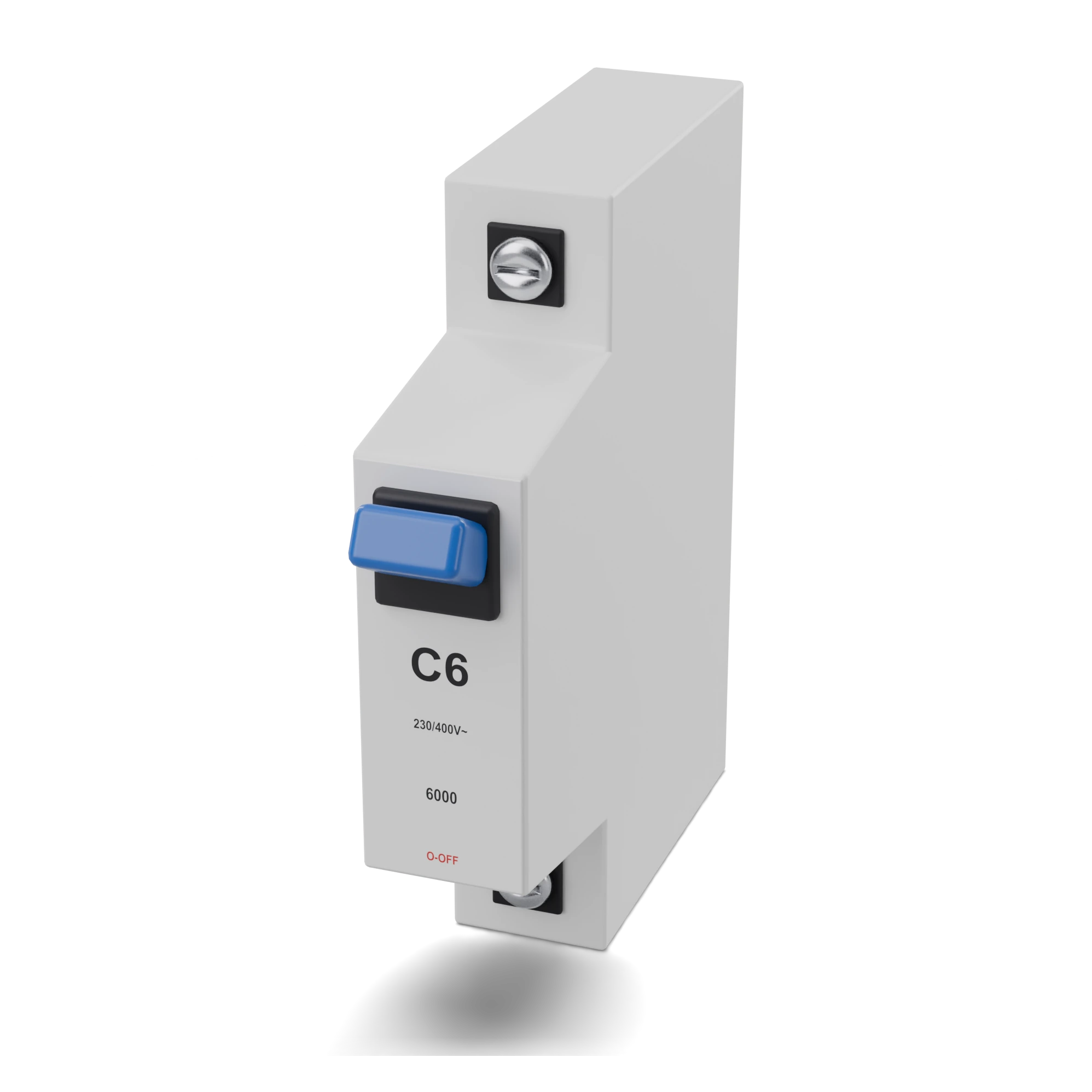
- 1Input screw (line)
- 2Operating lever (I on / O off)
- 3Curve and current: C0,5 (Lab) · 0.5 A, C curve
- 4Output screw (load)
DIN rail module ≈ 18 × 80 × 70 mm (depends on the series)
Circuit breaker / MCB (C0,5, 1 pole)
A fuse that switches itself off and can be reset. When the load is too high the breaker trips, and you lift the lever.
Opens the circuit on overload or a short circuit; works again without a new part.
The rows of small breakers in the fuse box of a house.
Narrow rectangular body with a lever on the front; a current rating code made of letters and a number is printed on top.
It does not protect against electric shock; do not experiment on the mains, examine it only at low voltage.
A single-pole miniature circuit breaker: it opens with a bimetal that heats up on overload and with an electromagnet on a high short-circuit current. A marking such as C0,5 means C curve and 0.5 A rated current; a common real-world example is C6 (6 A). The Lab uses low voltage only; real mains installation and wiring are outside the scope of this app.
IEC 60617: the drawing style used in Türkiye and Europe.
- Rated current (Lab)
- 0,5 A (C0,5)
- Selectable rated current (Lab)
- 0.1 / 0.25 / 0.5 / 1 / 6 A
- Magnetic tripping
- 5–10 × In; in the Lab model 5 × In and above (for C0,5: 2.5 A)
- Thermal test
- No tripping at 1.13 × In, tripping at 1.45 × In; 1-hour test
- Thermal behavior
- Depends on time, ambient temperature and preload
- Real example: C6
- 6 A rated, magnetic tripping 30–60 A
- Real example: voltage / breaking
- 230/400 V AC, 6 kA; depends on the series
- DC use
- Only with the manufacturer’s DC rating and wiring
- Protection type
- Overcurrent only; not residual-current (earth-leakage) protection
- Re-arming
- After the fault is cleared and the mechanism has cooled
- Example part
- Lab: C0,5, 1P; real example: C6, 1P, IEC 60898-1 class MCB
Test with a multimeter
Test whether this part is good with the multimeter on the measurement screen.
Take a measurement