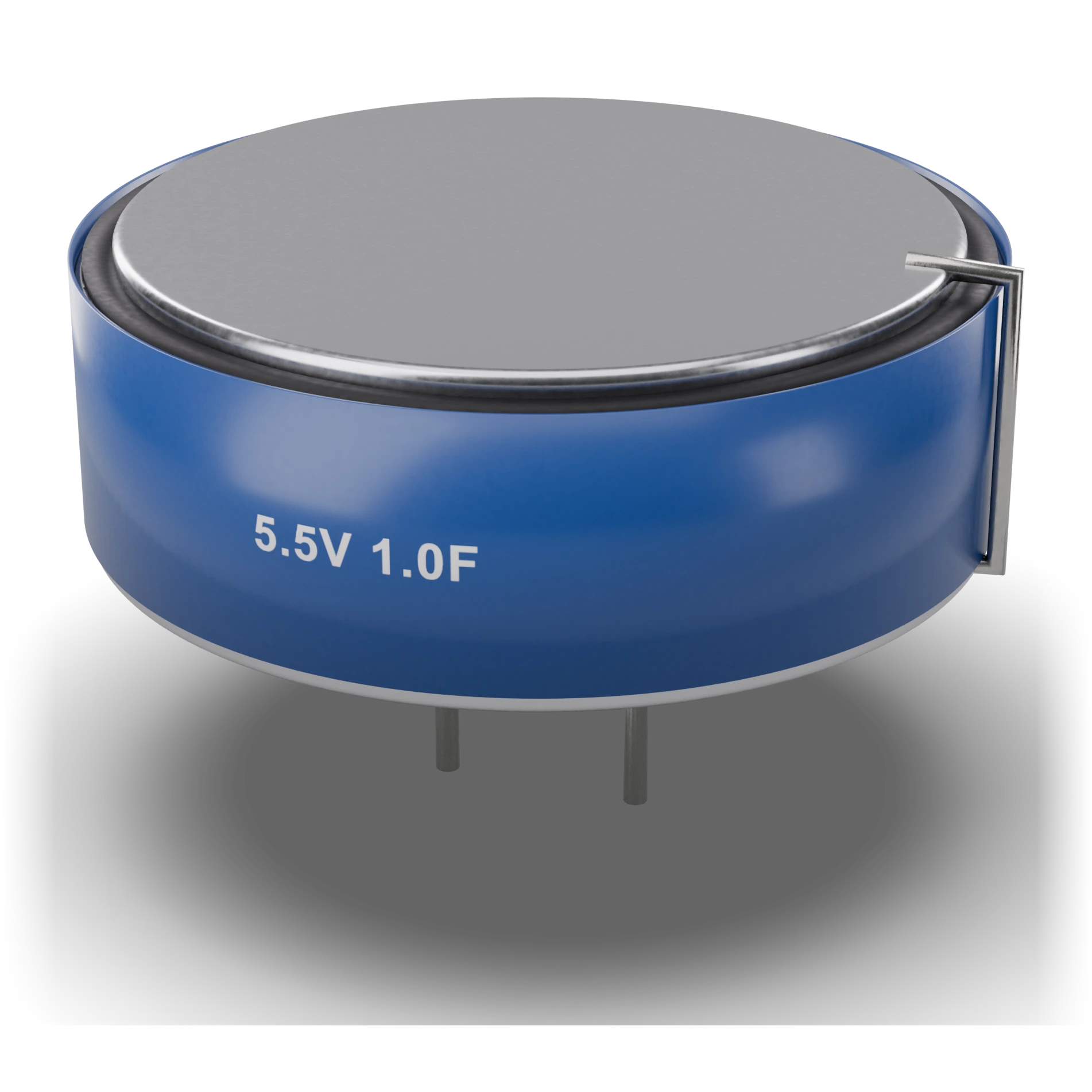
- 1Stainless steel cell case
- 2Pins · 5 mm spacing
- 3Outer casing (5.5 V 1 F)
Coin types are 1–2 cm in diameter; cylindrical types are larger
Supercapacitor
A very big bucket; it fills and empties electricity very fast, but it does not last as long as a battery.
Provides short-term backup energy; when the power goes out, the clock or memory continues to work for a while.
Inside clocks and devices that keep their settings during a short power cut.
A button or cylinder body; the farad value and voltage are printed on it, with plus and minus marks.
The voltage limit is low; it has polarity, so do not fit it in reverse and do not exceed the label voltage.
A capacitor with capacitance in the farads, storing energy in the double layer that ions form on the electrode surface. It charges much faster than a battery but its cell voltage is low (2.5–2.7 V). 5.5 V modules are made by connecting two cells in series.
IEC 60617: the drawing style used in Türkiye and Europe.
- Cell voltage
- 2.5–2.7 V
- Module voltage
- 5.5 V (2 cells in series)
- Capacitance range
- 0.1 F – 500 F (typical)
- ESR
- By type: from mΩ to tens of Ω
- Charging time
- Seconds, minutes
- Leakage
- Higher than a battery; self-discharges
- Example part
- 5.5 V 1 F coin type
Test with a multimeter
Test whether this part is good with the multimeter on the measurement screen.
Take a measurement