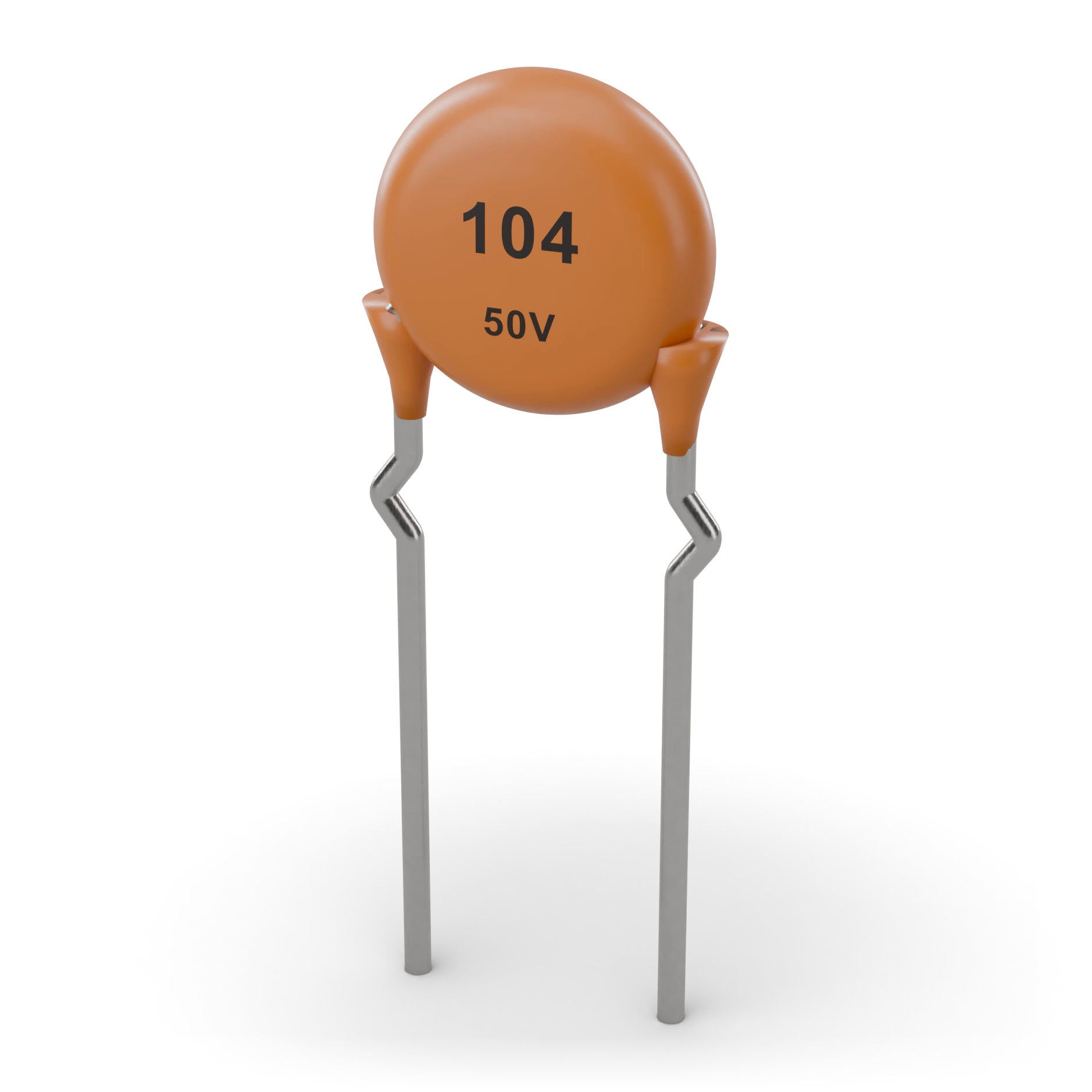
- 1Code 104 = 100 nF
- 2Epoxy dip coating
- 3Bent pins · 5 mm spacing
Disc diameter ≈ 4–10 mm, lead spacing 2.5 or 5 mm
Ceramic disc
A small, non-polarised bucket of electricity; it holds little but fills and empties very quickly.
Placed next to the IC, it absorbs noise; the circuit works stably.
Small discs on radios, toys and every kind of board.
A flat round disc and two legs; a three-digit code such as 104 is printed on it.
No polarity to worry about, but don't get the code reading wrong; 104 means one hundred nanofarads.
A small non-polarized capacitor made of a thin ceramic disc with metal coating on both faces. Its value is written as a three-digit code: 104, 10 and four zeros, in pF, which is 100 nF. It is cheap and the most-used capacitor on a breadboard.
IEC 60617: the drawing style used in Türkiye and Europe.
- Capacitance range
- 1 pF – 100 nF
- Voltage
- 50 V typical (kV types also exist)
- Reading the code
- 104 = 100 nF · 103 = 10 nF · 22 = 22 pF
- Tolerance
- ±10% (K) · ±20% (M) · +80/−20% (Z)
- Dielectric
- Class 1 (NP0/C0G) · Class 2
- Example part
- 104 (100 nF, 50 V)
Test with a multimeter
Test whether this part is good with the multimeter on the measurement screen.
Take a measurement