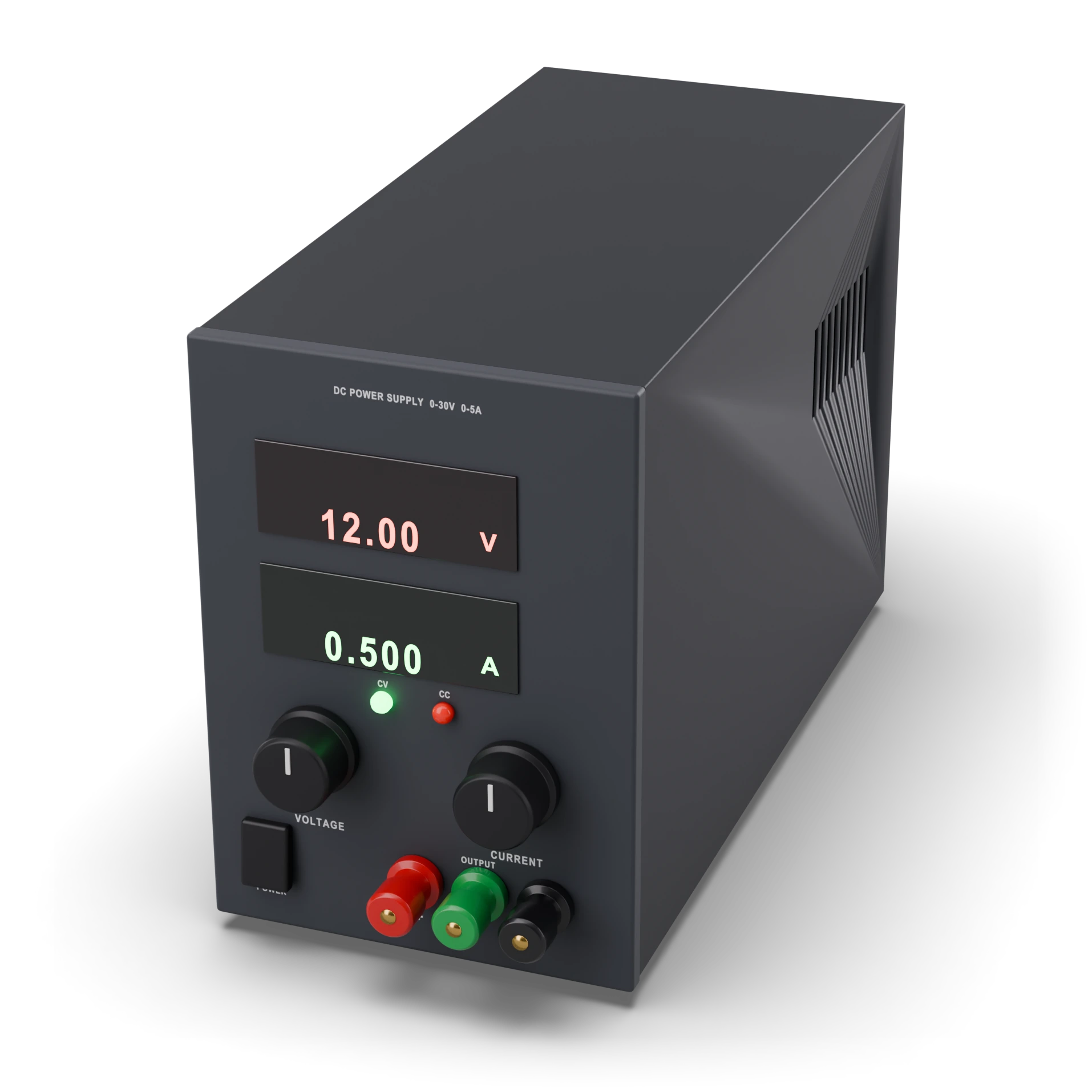
- 1Voltage display (V)
- 2Current display (A)
- 3Voltage adjustment (CV)
- 4Current limit adjustment (CC)
- 5On / off switch
- 6Output terminals (+ red, − black) · green: chassis ground
Benchtop power supply; current and voltage setting on the front panel
Current source (constant current, bench CC mode)
A source that always tries to push the same amount of current. Like a pump that moves water at the same speed uphill or on the flat.
The current stays constant even if the load changes; you see how the voltage moves accordingly.
While a phone charges, when the battery is empty the charger mostly keeps the current constant.
A bench box with current and voltage knobs on the front; there are two output sockets.
The voltage is not unlimited; with the output open or a very large load the current goal cannot be reached.
A source that adjusts its output voltage to keep the current through the load constant. A lab supply’s CC mode shows this behavior at the current limit. The voltage does not rise without limit; when it reaches the compliance voltage limit, the target current cannot be supplied and the source switches to CV mode.
IEC 60617: the drawing style used in Türkiye and Europe.
- Example current
- 10 mA adjustable
- Mode
- CC, constant current
- Compliance voltage
- At most 30 V on the example source
- Load effect
- In the CC range the voltage varies with the load
- Circuits: Light
- Reaches the voltage limit; the current drops to zero
- Short circuit
- Limits the current; power and connection limits apply
- Ideal model
- Mathematical approximation with no compliance limit
- Example part
- 0–30 V lab supply, example of 10 mA in CC mode
Test with a multimeter
Test whether this part is good with the multimeter on the measurement screen.
Take a measurement