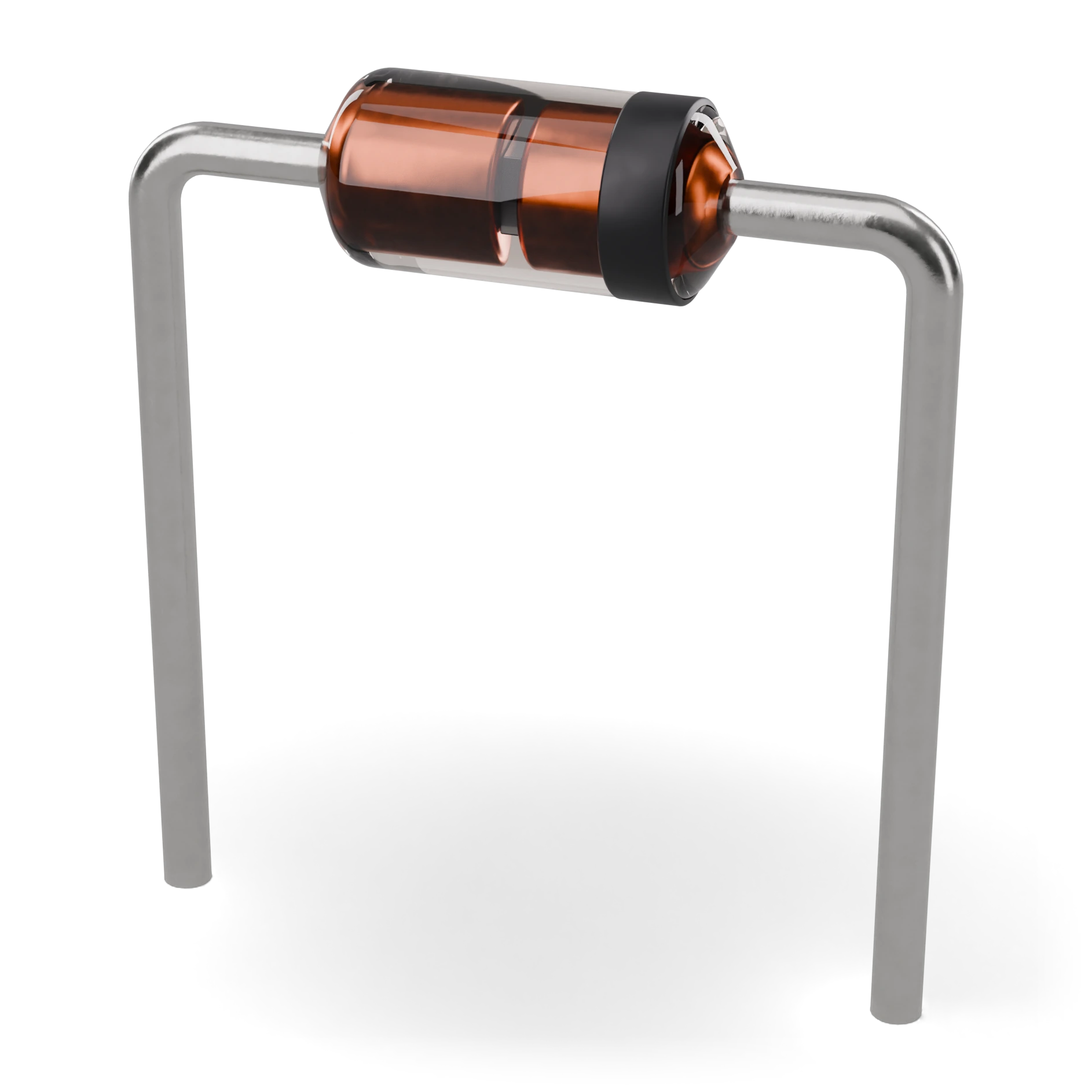
- 1Glass body (DO-35) · Ø 1.85 × 3.8 mm
- 2Dumet lead (copper-clad)
- 3Cathode band
- 4Pins
DO-41 body ≈ 5 × 2.7 mm · Example shown: 5.1 V zener, DO-35 glass case
Zener diode
In reverse, a bucket that overflows at a certain voltage; it drains the excess and keeps the level constant.
Keeps the voltage at a fixed value; works as a simple reference or protection.
Inside power supplies and small regulator circuits.
A black or glass cylinder with a strip at one end; it looks like a rectifier diode and is told apart by the code on it.
Do not connect it without a series resistor, or too much current will burn it out; remember that it works in the reverse direction.
A diode that starts conducting at a certain reverse voltage (the zener voltage) and tries to hold that voltage constant. Together with a series resistor it forms a simple regulator or reference source. In the forward direction it behaves like a normal diode.
IEC 60617: the drawing style used in Türkiye and Europe.
- Zener voltage
- 5.1 V (±5%, at 49 mA)
- Power
- 1 W
- Test current
- 49 mA
- Max. zener current
- ≈178 mA
- Dynamic resistance
- ≤ 7 Ω
- Streak
- 1N4728A–1N4764A: 3.3–100 V
- Example part
- 1N4733A (5.1 V, 1 W)
Test with a multimeter
Test whether this part is good with the multimeter on the measurement screen.
Take a measurement