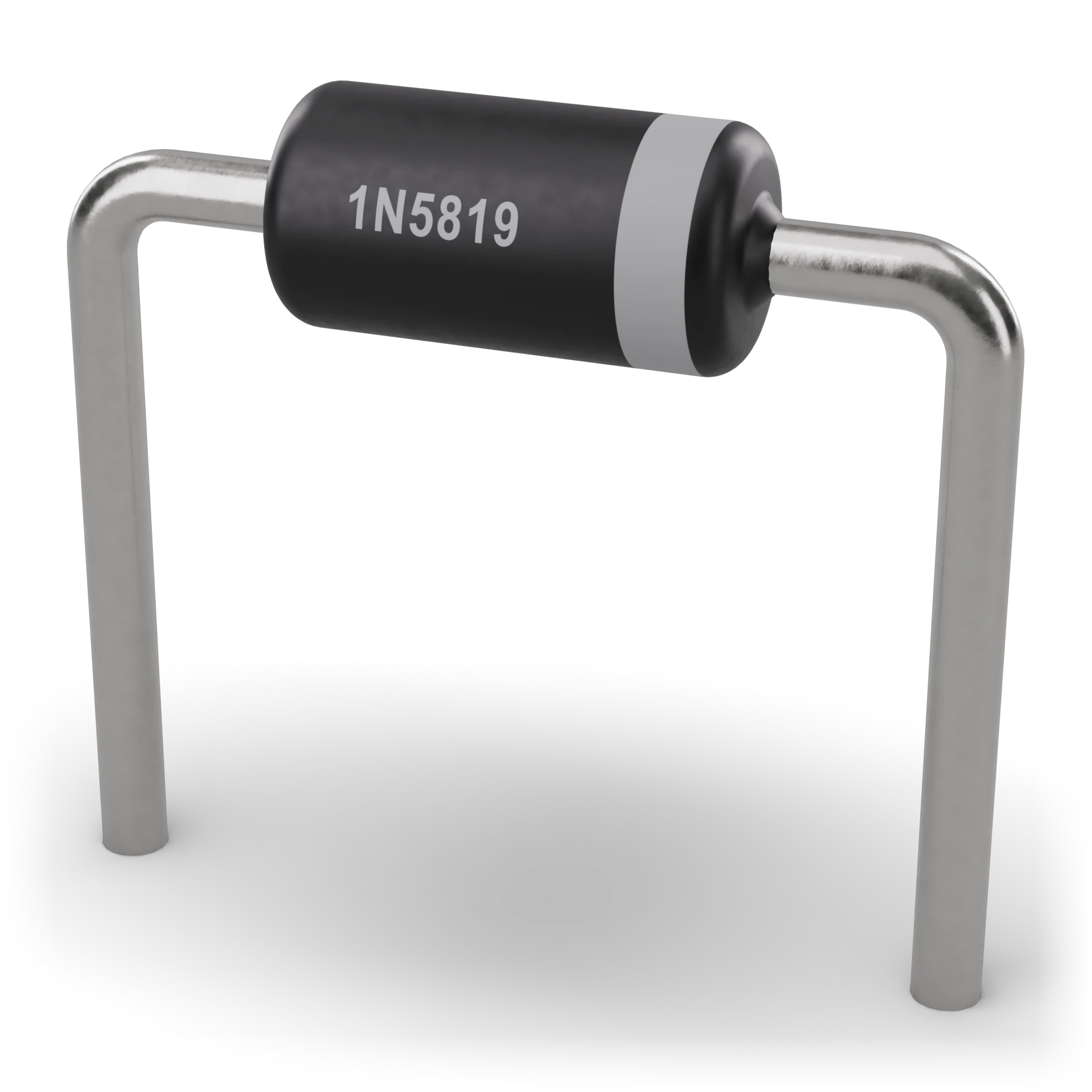
- 1Epoxy body (DO-41) · Ø 2.7 × 5.2 mm
- 21N5819 · Vƒ ≈ 0.45 V
- 3Cathode band (gray)
- 4Pins (anode / cathode)
DO-41 body ≈ 5 × 2.7 mm
Schottky diode
A fast one-way gate that loses very little energy; it holds you up only slightly as you pass.
Very little voltage drops across it; energy is not wasted in battery and switching circuits.
Phone chargers, solar panels and battery-powered devices.
A black cylinder that looks like a normal diode, with a stripe at one end; you tell it apart by the code on top.
It has low tolerance of reverse voltage and leaks a little in the reverse direction; check its label.
A diode made from a metal–semiconductor junction instead of a P-N junction. Its forward voltage drop is small and it switches very fast. The price is that reverse leakage current is higher than a normal diode’s and its reverse voltage limit is low.
IEC 60617: the drawing style used in Türkiye and Europe.
- Max. reverse voltage
- 40 V
- Average current
- 1 A
- Forward voltage
- ≤ 0.6 V (1 A)
- Surge current
- 25 A
- Reverse leakage
- ≤ 1 mA (25 °C, 40 V)
- Streak
- 1N5817: 20 V · 1N5818: 30 V · 1N5819: 40 V
- Example part
- 1N5819 (40 V, 1 A)
Test with a multimeter
Test whether this part is good with the multimeter on the measurement screen.
Take a measurement