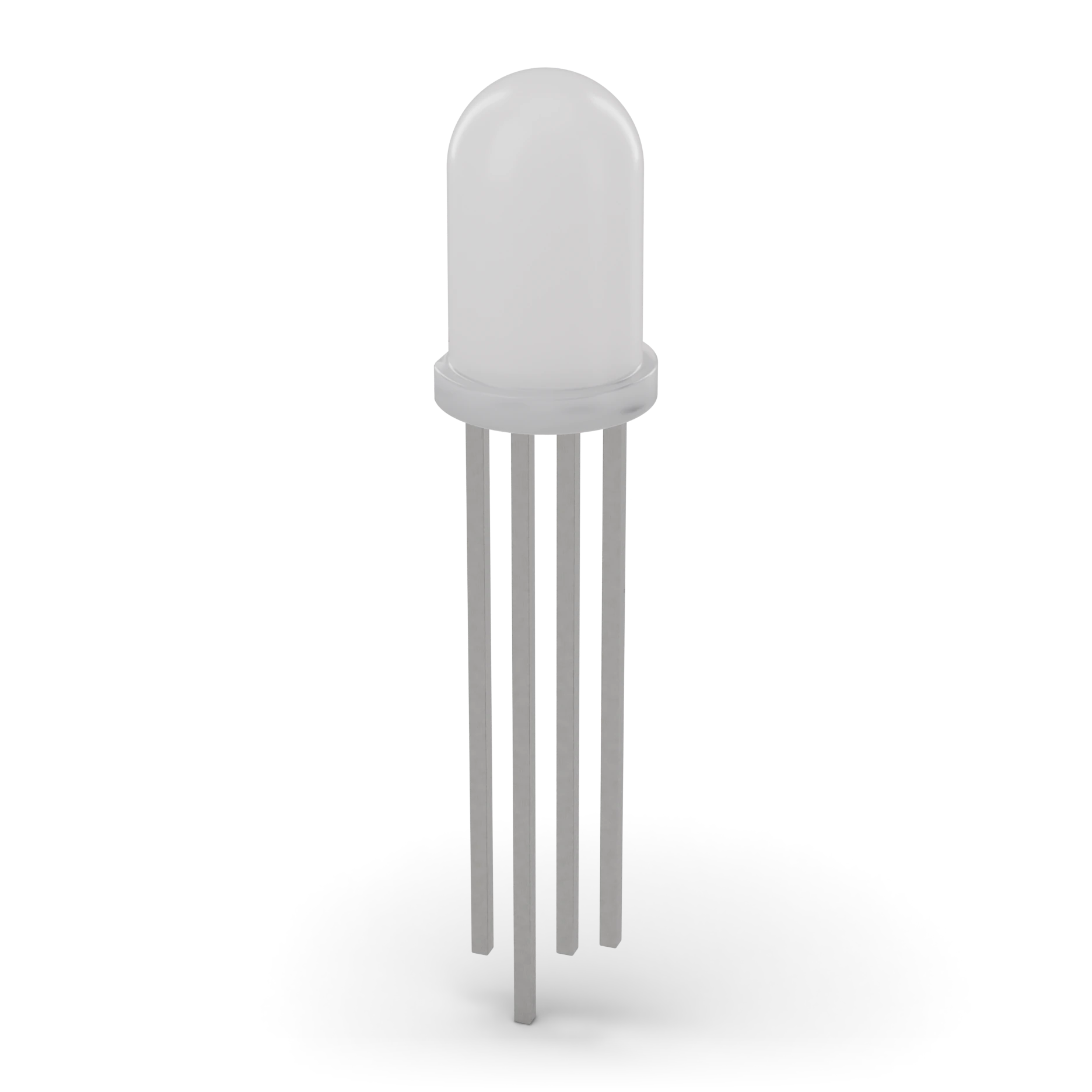
Epoxy lens · Ø 5 mmR / G / B anode pinsCommon cathode (longest pin)
- 1Epoxy lens · Ø 5 mm
- 2R / G / B anode pins
- 3Common cathode (longest pin)
Frosted or clear 5 mm dome, four legs of different lengths
5 mm diameter, four legs of different lengths
5 mm diameter, four legs of different lengths
RGB LED
In simple terms
What is this?
Three small lamps in a single dome: red, green, blue. It makes every colour by mixing them.
What is it for?
You set the brightness of the three colors separately and make any color you want.
Where do you see it?
In colour-changing LED strips, gaming keyboards and decorative lights.
How do you spot it?
Four legs in one dome; the common leg is longer than the others.
Caution:
Use a separate resistor for each colour; check whether the common pin is a cathode or an anode.
Technical definition
Holds three LED chips, red, green and blue, in one dome. By adjusting the brightness of each color separately (usually with PWM) you can mix almost any color. It comes in two types: common cathode and common anode.
TypeCommon cathode / anode
Forward voltageR ≈2 V · G/B ≈3 V
Current20 mA / color
Schematic symbol Same in IEC and ANSI
IEC 60617: the drawing style used in Türkiye and Europe.
Pins 4
1Red (R)Alone on one side of the common pinR
2Common cathodeLongest pin; goes to GNDK
3Green (G)On the other side of the common pin, the first in the rowG
4Blue (B)The outermost leg; the order can change by modelB
Features typical
- Red Vf
- 1.8–2.2 V
- Green Vf
- ≈3.0–3.3 V
- Blue Vf
- 3.0–3.3 V
- Current
- 20 mA / color (max.)
- Types
- Common cathode · common anode
- Mix
- R+G = yellow · G+B = cyan · R+B = purple
- Example part
- 5 mm common-cathode RGB LED
Common mistakes
A single resistor on the common pinBecause the colors have different forward voltages, one resistor splits the current unevenly. Put a separate resistor on each color leg.
Mixing up the typeOn a common anode, the common leg goes to positive and a color lights when its leg is pulled to ground. Learn its type first by measuring.
Guessing pin orderThe order can vary by model. Before plugging it in, light each color one at a time with the multimeter's diode mode.
Test with a multimeter
Test whether this part is good with the multimeter on the measurement screen.
Take a measurementWhere it is used
Colored status lightAmbient light and color mixingIndicator that changes color with temperature
Related lessons