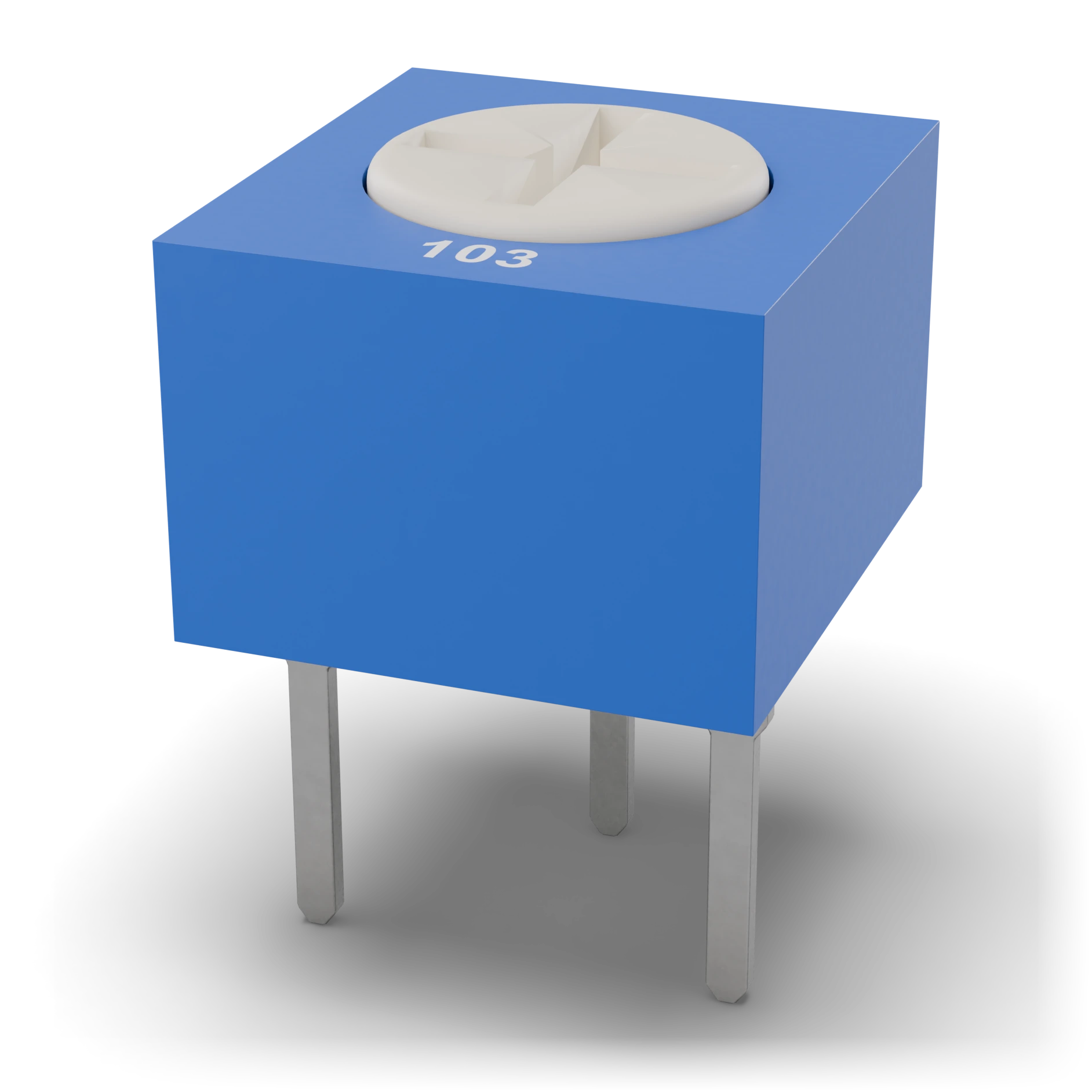
- 1Adjustment rotor (screwdriver slot)
- 2Body · 103 = 10 kΩ
- 3Pins 1-2-3 (middle = wiper)
3296W: ≈ 9.5 × 10 × 4.8 mm, pin pitch 2.54 mm · Example shown: 3362P, single-turn trimpot (103 = 10 kΩ)
Trimpot
A tiny adjustment screw on the board; a small tap you set once and forget.
Lets you fine-tune something once during setup and leave it fixed, like contrast or a threshold.
Small adjustment screws on old measuring instruments, monitors and radio boards.
A small box with a screw that has a screwdriver slot on top; three legs underneath.
Turn it slowly with a small screwdriver; if you force it at the end, the screw breaks.
A small potentiometer adjusted with a screwdriver. It is soldered onto the board for settings that rarely change, such as calibration or screen contrast. Multi-turn types allow very fine adjustment.
IEC 60617: the drawing style used in Türkiye and Europe.
- Value code
- 103 = 10 kΩ · 502 = 5 kΩ
- Tolerance
- ±10%
- Power
- 0.5 W (70 °C)
- Number of turns
- 3296: 25 turns · 3362: single turn
- Track
- Cermet
- Example part
- 3296W (25 turns) · 3362P (single turn)
Test with a multimeter
Test whether this part is good with the multimeter on the measurement screen.
Take a measurement