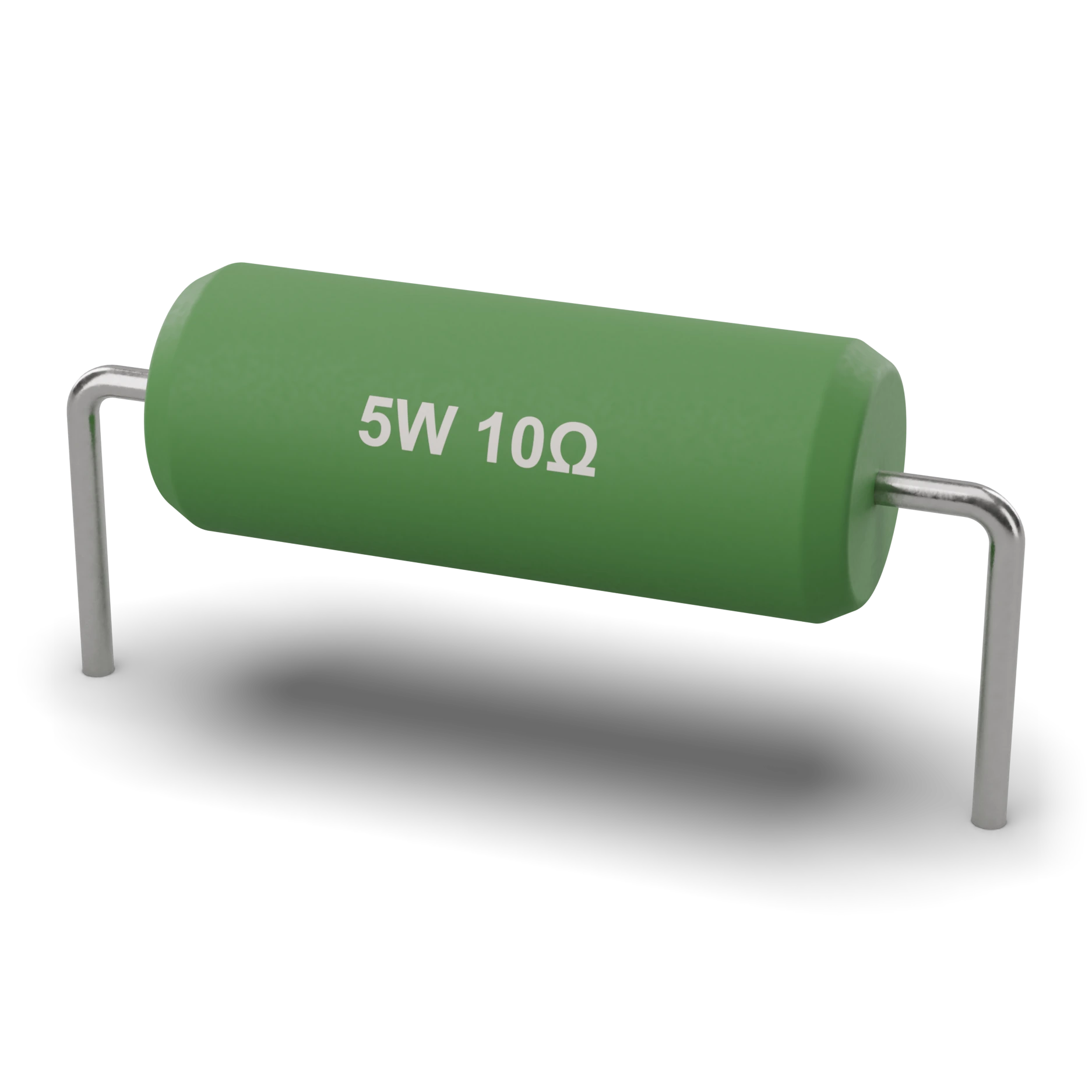
- 1Silicone coating · 5 W, 10 Ω
- 25W 10Ω marking
- 3Thick pins (Ø 0.8 mm)
Varies with power: from small axial types to metal-cased types a few cm long
Wire-wound resistor
Thin wire wound around a ceramic rod; it is a long, narrow, sturdy pipe.
Handles high power; suitable for measuring current and for use as a load.
Big, high-power resistors inside power supplies and amplifiers.
A ceramic or glassy body with wire wound inside; much bigger than a normal resistor, with its power rating written on it.
It gets very hot while working; leave the area around it free and do not touch it.
Made by winding resistance wire (such as nickel-chrome) onto a ceramic or fiberglass core. It handles high power and can be made very precisely at small values. Because the winding behaves like an inductor, it can cause trouble with fast signals.
IEC 60617: the drawing style used in Türkiye and Europe.
- Power
- 1–10 W (axial), cased types more
- Tolerance
- ±1% · ±5%
- Value range
- 0.1 Ω – 10 kΩ (typical)
- Inductance
- Yes (because of the winding)
- Surface temperature
- Can exceed 200 °C at full power
- Example part
- 5 W axial wire-wound
Test with a multimeter
Test whether this part is good with the multimeter on the measurement screen.
Take a measurement