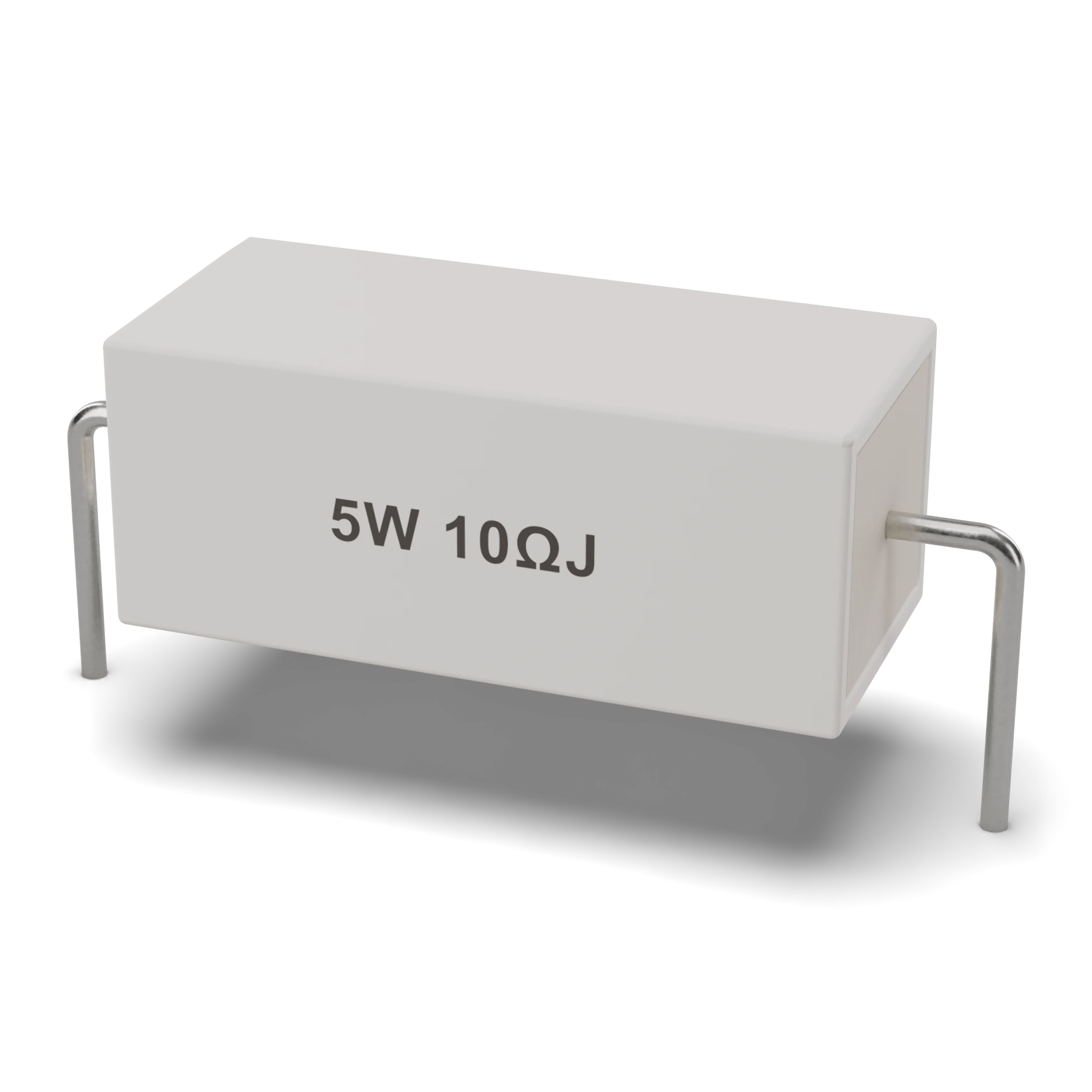
- 1Ceramic box · 22 × 10 × 9 mm
- 2End filler (cement)
- 35W 10ΩJ (J = 5%)
- 4Pins
Varies with power; the 5 W type is about 2 cm long
Cement (power) resistor
A powerful resistor embedded in a white ceramic case; a sturdy pipe that turns excess flow into heat.
Turns a few watts of power into heat; used for discharging batteries and capacitors and for loading.
In power supplies and amplifiers: big white rectangular parts.
A white rectangular ceramic case and two pins; the value and power are printed on it in plain text.
It gets very hot; do not stick it to the board, leave an air gap under it and do not touch it.
A power resistor sealed with cement-like filler in a white ceramic box. It usually has a wirewound or metal-oxide element. Its value and power are printed on the body.
IEC 60617: the drawing style used in Türkiye and Europe.
- Power
- 2 · 3 · 5 · 10 · 20 W
- Tolerance
- ±5% (J)
- Internal structure
- Wire-wound or metal oxide
- Marking
- Plain text, e.g. “5W 10Ω J”
- Surface temperature
- Gets very hot at full power
- Example part
- SQP series 5 W
Test with a multimeter
Test whether this part is good with the multimeter on the measurement screen.
Take a measurement