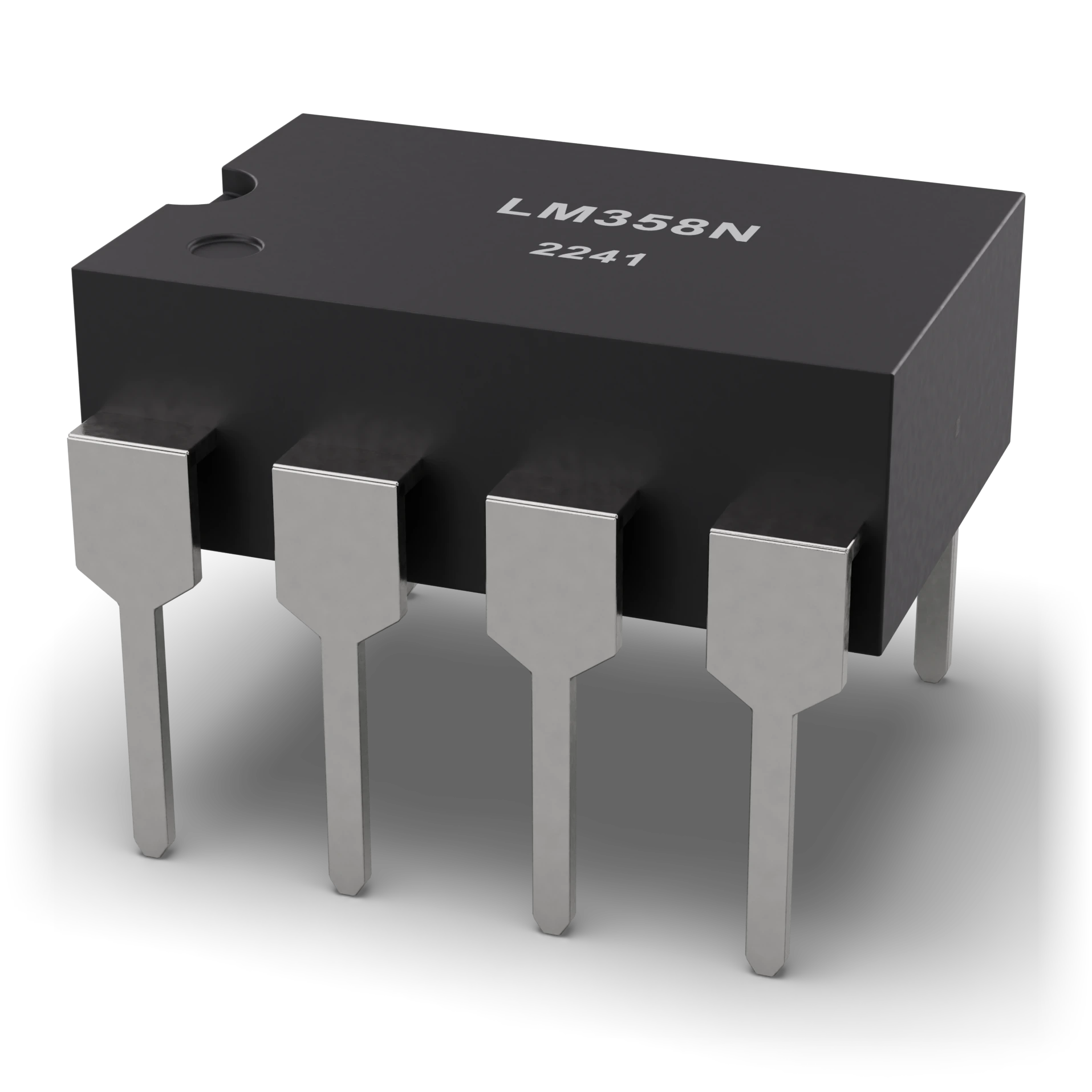
- 1Pin 1 notch
- 2LM358N dual op-amp
- 3Pin 1 dot
- 4Epoxy body (DIP-8) · 9.6 × 6.35 mm
- 5Pins (2.54 mm pitch)
DIP-8: body ≈ 9.8 × 6.4 mm, pin pitch 2.54 mm
Op-amp (LM358)
A small magnifying glass that compares two inputs and enlarges the difference; it makes a tiny difference obvious.
Amplifies a small sensor signal, or compares two voltages and answers yes or no.
In boards with sensors and in audio amplifiers.
A small black IC with eight legs in two rows; the type code is printed on top.
Count the pins from the notched end; its output does not reach the full supply voltage.
A common IC containing two operational amplifiers (op-amps) in one package, able to run from a single supply. The input range includes ground (0 V), which makes it handy for sensor signals. Its output cannot quite reach the supply voltage.
IEC 60617: the drawing style used in Türkiye and Europe.
- Power supply
- 3–32 V (single) · ±1.5–±16 V (dual)
- Gain-bandwidth
- ≈1 MHz (0.7 MHz in some datasheets)
- Input range
- From 0 V to VCC − 1.5 V
- Output swing
- Close to 0 V, at most ≈ VCC − 1.5 V
- Input offset
- ≤ 7 mV
- Slew rate
- ≈0.3 V/µs
- Power supply current
- ≈0.5–1 mA
- Example part
- LM358N (DIP-8)
Test with a multimeter
Test whether this part is good with the multimeter on the measurement screen.
Take a measurement