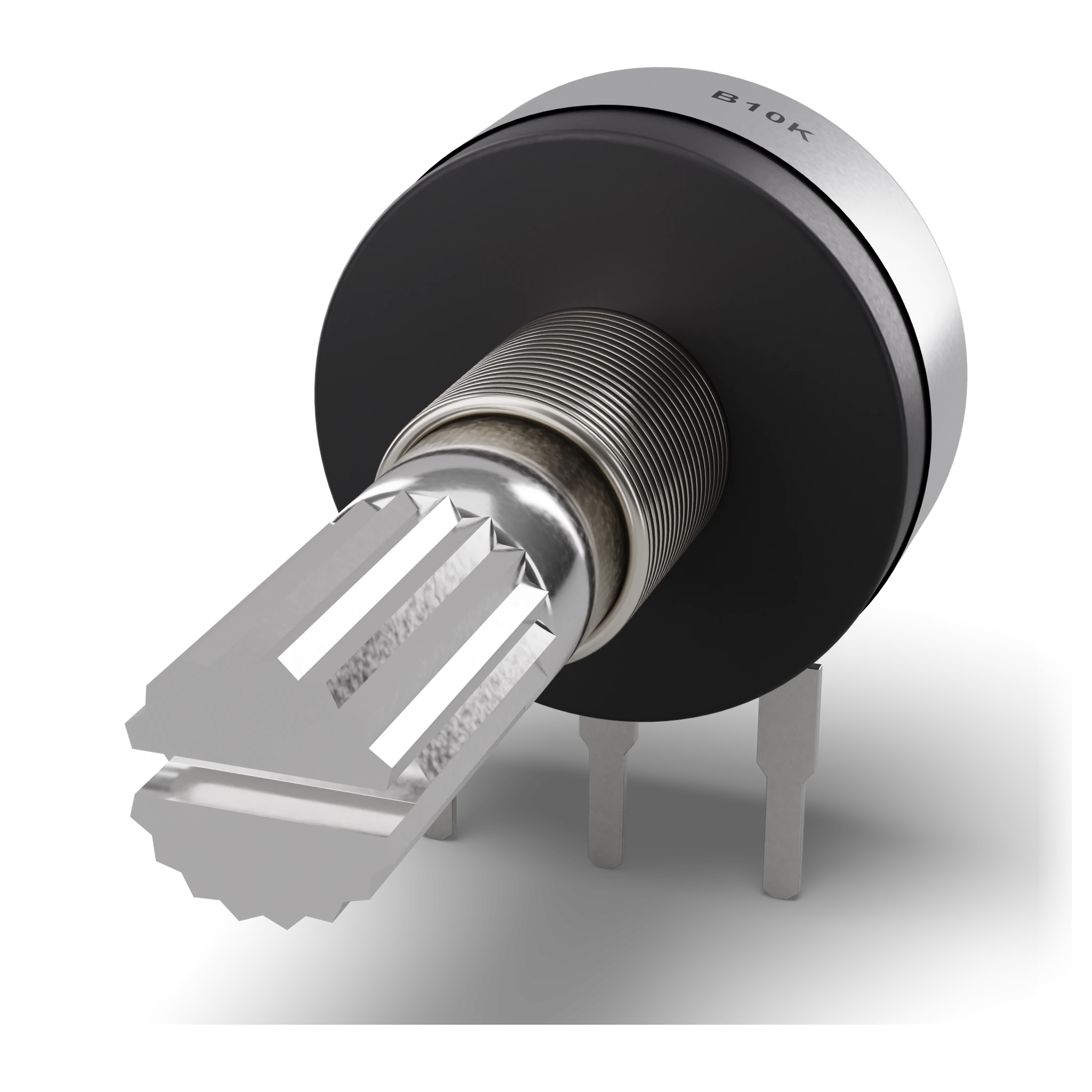
- 1Metal cover (B10K)
- 2Plastic body
- 3Threaded bushing · M7 × 0.75
- 4Knurled shaft · Ø 6 mm
- 5Pins 1-2-3 (middle = wiper) · 5 mm spacing
Body diameter ≈ 16 mm, shaft diameter ≈ 6 mm
Potentiometer
Like a tap you turn by hand; the more you turn, the more or less flow passes.
Lets you adjust volume, brightness or speed by hand.
In a speaker's volume knob and in the knobs of a guitar amp.
A round box with a rotating shaft in the middle, a turning knob on top and three legs underneath.
At zero, no resistance is left; still put a fixed resistor in front of a part like an LED.
A variable resistor in which a turning shaft carries a sliding contact (wiper) over a resistive track. The resistance between the two outer pins is fixed; the resistance between the middle pin and the ends changes as the shaft turns. It is mostly used as a voltage divider.
IEC 60617: the drawing style used in Türkiye and Europe.
- Value
- 1 kΩ – 1 MΩ (10 kΩ common)
- Tolerance
- ±20%
- Curve
- B = linear, A = logarithmic
- Rotation angle
- ≈300°
- Power
- Low, usually under 0.5 W
- Track
- Carbon · cermet · conductive plastic
- Example part
- 16 mm rotary pot, B10K
Test with a multimeter
Test whether this part is good with the multimeter on the measurement screen.
Take a measurement