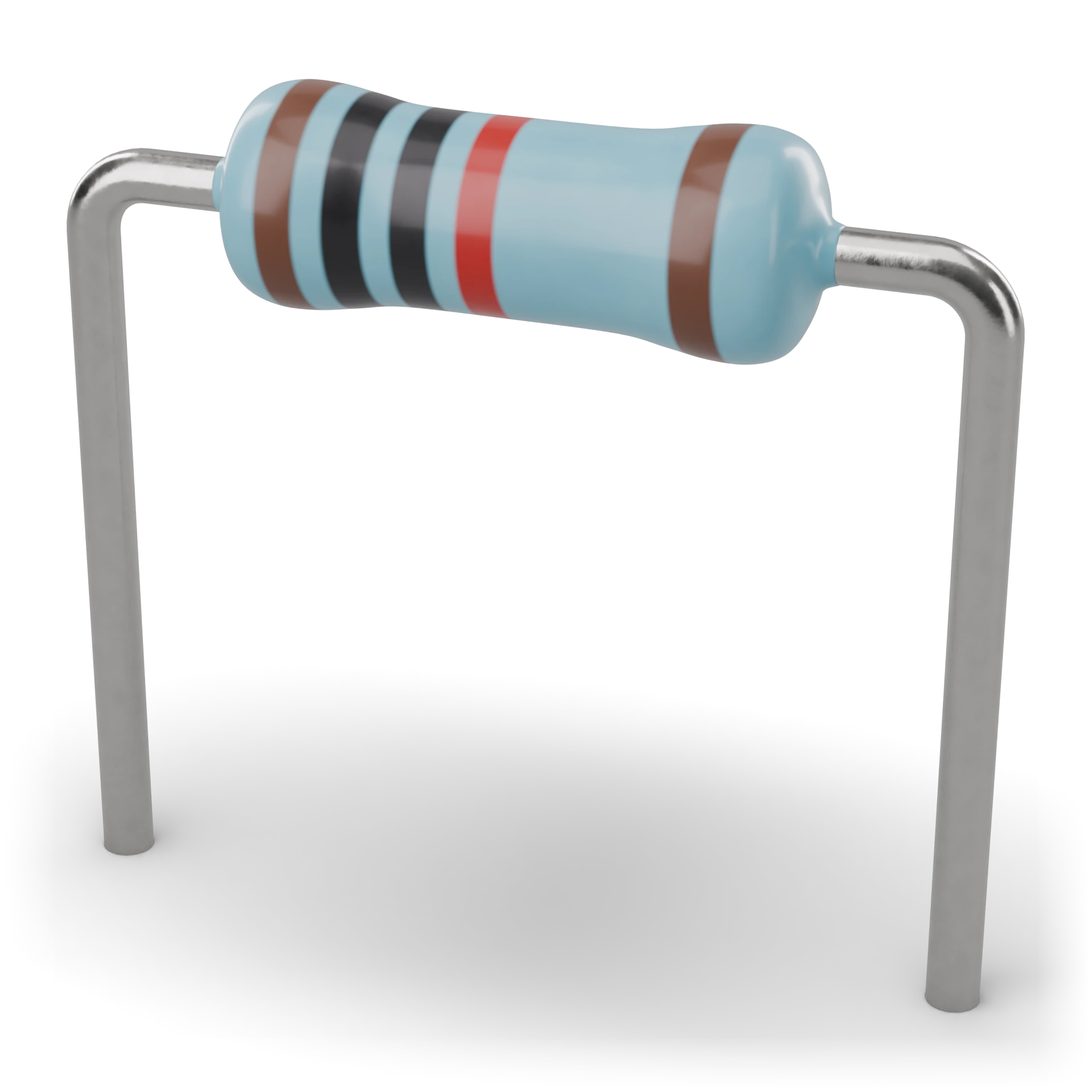
- 1Lacquer coating (5 bands) · brown-black-black-red = 10 kΩ
- 2Tolerance band (brown = 1%)
- 3Pins
Body ≈ 6.3 × 2.4 mm, leg ≈ 28 mm
Metal film resistor
The same narrow pipe as a carbon resistor, but made more neatly and more precisely.
Its value changes little with temperature and its noise is low; it gives precise adjustment in measurement and audio circuits.
On the boards of audio amplifiers and measuring instruments.
Usually a blue cylindrical body with five colored bands; it is told apart from the carbon type by the number of bands.
Do not read five bands as four bands; if you mix up the reading direction, you get a wrong value.
A fixed resistor made by coating a thin layer of metal alloy (mostly nickel-chrome) on a ceramic rod. Its value changes little with temperature and it has low noise. The body is usually blue and coded with five bands.
IEC 60617: the drawing style used in Türkiye and Europe.
Reading direction: hold it with the tolerance band (usually gold) on the right. If you are color-blind, read the value from the text above.
- Power
- 0.25 W (70 °C)
- Tolerance
- ±1% (brown band)
- Temperature coefficient
- ±50–100 ppm/°C
- Value series
- E96 (E24 is also available)
- Value range
- 1 Ω – 10 MΩ
- Max. operating voltage
- 250 V
- Example part
- MF 1/4 W ±1% (MFR-25)
Test with a multimeter
Test whether this part is good with the multimeter on the measurement screen.
Take a measurement