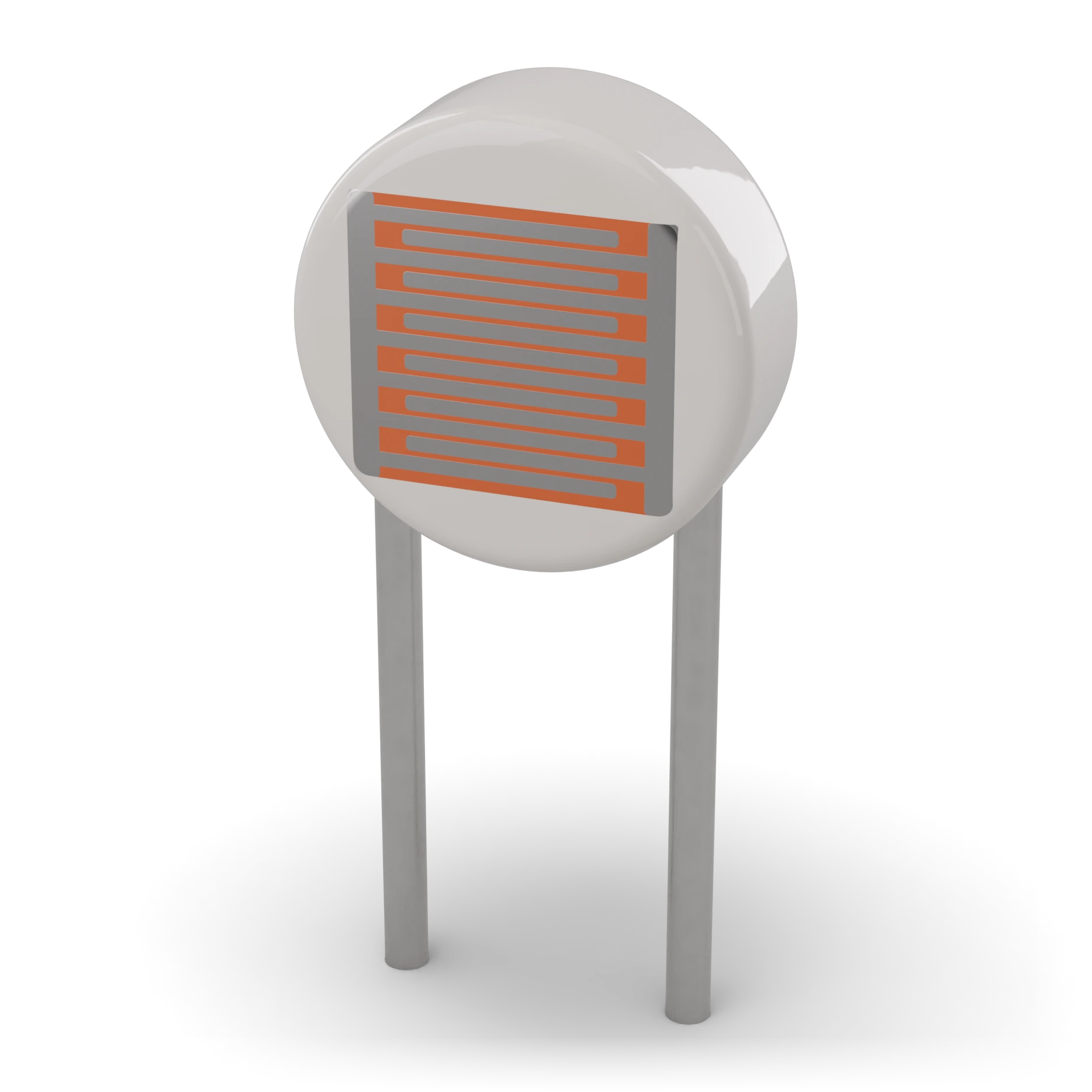
- 1CdS (cadmium sulfide) track · resistance drops with light
- 2Clear epoxy face
- 3Pins · 3.4 mm spacing
Body diameter ≈ 5 mm, two long legs
LDR (photoresistor)
A gate that passes electricity easily in light and poorly in darkness.
Tells the circuit whether the surroundings are light or dark; a night light switches on by itself.
In night lights that switch on by themselves in the dark.
A small round surface with a winding line pattern and two legs.
Do not connect it on its own, put a resistor next to it; it suits the question "is it bright?", not fine measurement.
A sensor whose resistance falls as light increases. In the cadmium sulfide layer, more charge carriers are freed as it receives light, and conductivity rises. It responds slowly; it suits threshold detection better than precise measurement.
IEC 60617: the drawing style used in Türkiye and Europe.
- Resistance (10 lux)
- 8–20 kΩ
- Dark resistance
- ≥ 1 MΩ
- Max. power
- 100 mW
- Max. voltage
- 150 V DC
- Peak sensitivity
- ≈540 nm (green)
- Response
- Tens of ms (slow)
- Material
- Cadmium sulfide (CdS)
- Example part
- GL5528
Test with a multimeter
Test whether this part is good with the multimeter on the measurement screen.
Take a measurement