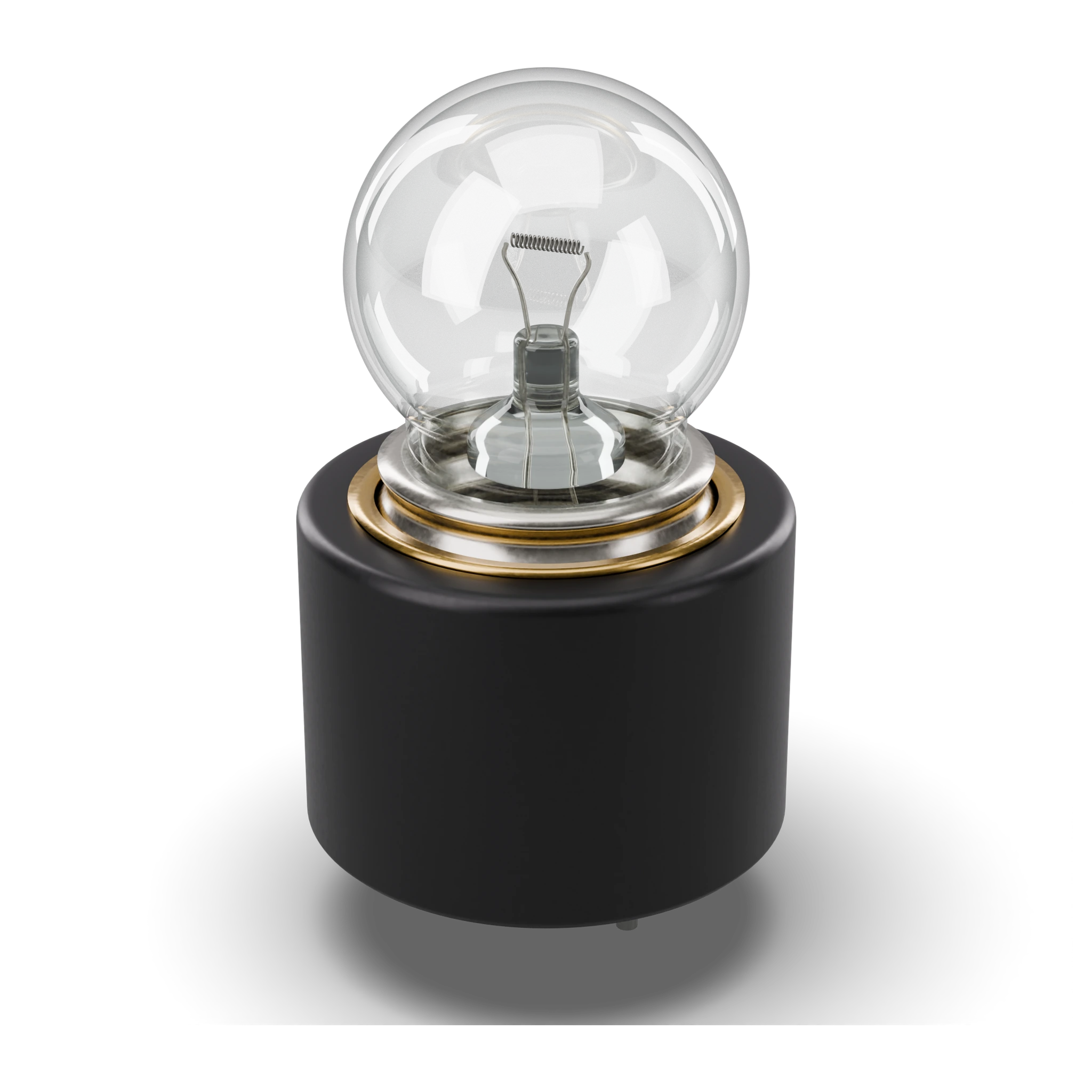
- 1Tungsten filament
- 2Glass bulb · Ø 11 mm
- 3Socket (lamp holder) · E10
- 4Connection pin
E10 screw diameter 10 mm; glass diameter ≈ 10 mm, length ≈ 23 mm (depends on the model)
Incandescent lamp (E10, 6 V 0.1 A)
A small glass bulb with a thin wire glowing inside. As the wire heats up it turns red and gives off light.
Gives light when current passes; the old way of showing by eye that a circuit works.
In old incandescent bulbs and old flashlights.
A small glass bulb with a screw-threaded metal body below it; it has two contacts: the tip at the bottom and the screw.
Do not go above the voltage on the label, the wire burns; a lit bulb is very hot, do not touch it.
The thin tungsten filament inside the glass bulb heats up with current and gives off light. It is not a semiconductor like an LED and has no polarity. When cold, the filament’s resistance is about one tenth of its hot value; at switch-on it briefly draws a high current.
IEC 60617: the drawing style used in Türkiye and Europe.
- Rated voltage
- 6 V DC or 6 V RMS AC
- Rated current
- 0.1 A
- Power
- 0.6 W
- Hot resistance
- ≈60 Ω (at the rated point)
- Cold resistance
- ≈6 Ω; hot value about 10 times
- Inrush current
- For a short time about 10 times the rated current
- Socket
- E10, two separate contacts
- Example part
- E10 miniature bulb, 6 V 0.1 A
Test with a multimeter
Test whether this part is good with the multimeter on the measurement screen.
Take a measurement