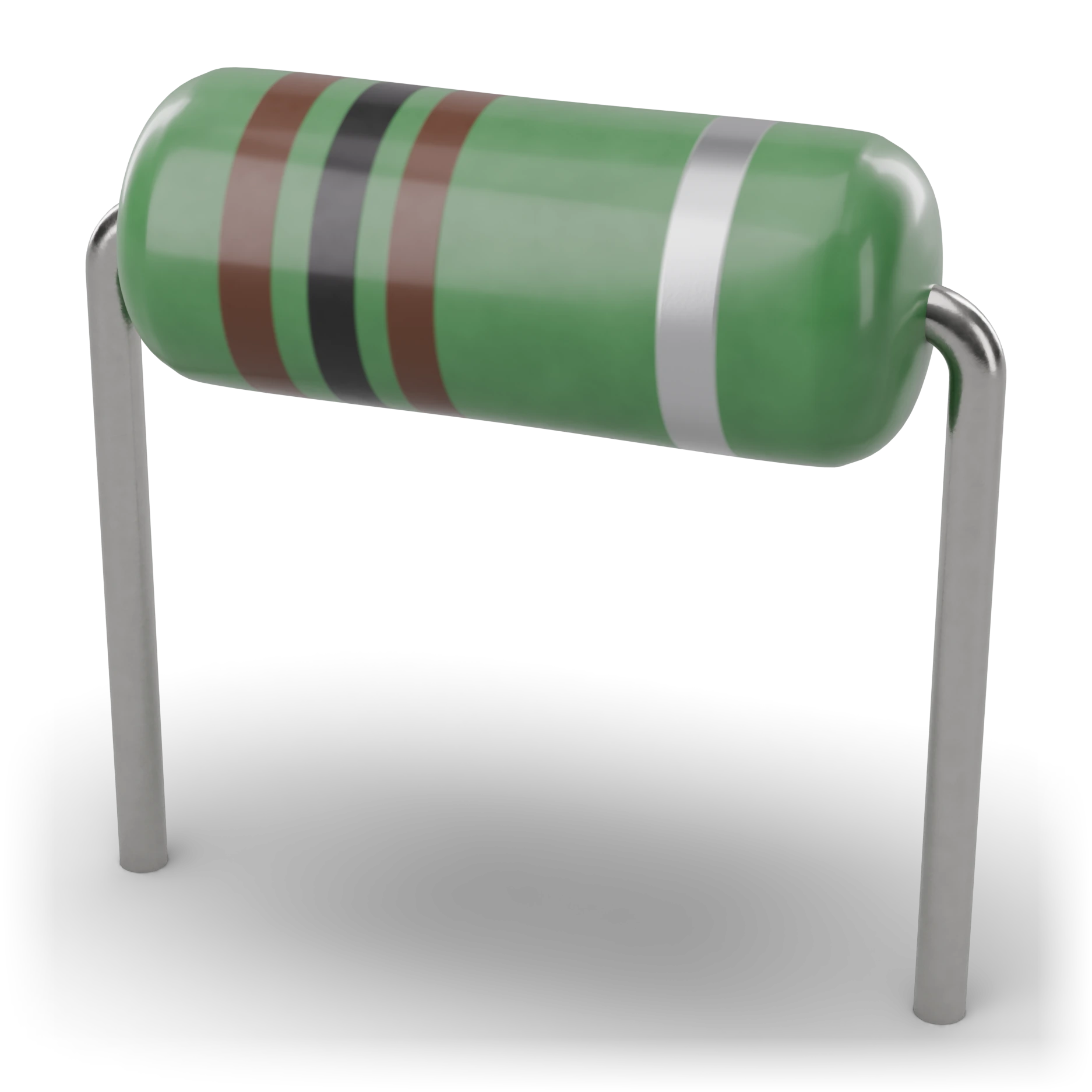
- 1Epoxy coating and color bands · brown-black-brown = 100 µH
- 2Silver band (10%)
- 3Pins
Body ≈ 8–12 × 3–5 mm; two axial pins (depends on the series)
Inductor / coil (100 µH)
The heavy flywheel of electricity. When current wants to change suddenly it resists; a heavy wheel also delays speeding up and stopping.
Slows sudden changes in current; smooths ripple in filter and power circuits.
Small cylinders made of wound wire, inside computers and chargers.
A small cylinder that looks like a resistor; it has thin wound wire inside, and two pins come out of the ends.
If you cut the current suddenly, a spark or high-voltage spike appears; with current above the limit it cannot do its job.
A passive component made by winding insulated copper wire around a core. It stores energy in a magnetic field and produces a voltage that opposes sudden changes in the current through it. In steady DC an ideal inductor behaves like a short circuit; a real inductor has the DC resistance of its wire.
IEC 60617: the drawing style used in Türkiye and Europe.
- Inductance
- 100 µH
- Tolerance
- ±10% or ±20%
- DC resistance (DCR)
- ≈0.3–1 Ω (example axial series)
- Saturation current (Isat)
- In series; the current at which inductance drops by the stated ratio
- Heating current (Irms)
- Limited by the allowed temperature rise
- Energy
- E = ½ × L × I²
- High frequency
- Above its self-resonant frequency it does not behave like an inductor
- Example part
- 100 µH axial ferrite inductor
Test with a multimeter
Test whether this part is good with the multimeter on the measurement screen.
Take a measurement